
Hepatology: Diagnosis and Therapeutic Response
‘We combine biomarkers, molecular mechanisms and patient-derived models to advance the diagnosis and personalised treatment of hepatobiliary cancer’
DR. MARÍA ARECHEDERRA CALDERÓN RESEARCHER. HEPATOLOGY RESEARCH GROUP: DIAGNOSIS AND THERAPEUTIC RESPONSE
Hepatocellular carcinoma and cholangiocarcinoma are tumours with high mortality rates that are often diagnosed at advanced stages and respond only to a limited extent to available treatments, including immunotherapy. Improving their prognosis requires tools that enable earlier detection, better characterisation of each patient, and an understanding of the mechanisms that determine response to or resistance against treatment.
Our group, based at the Cancer Center Clínica Universidad de Navarra, conducts translational research that combines the molecular study of tumours with the development of biomarkers, the analysis of mechanisms of response and resistance to treatment, and patient-derived models to identify new therapeutic opportunities.
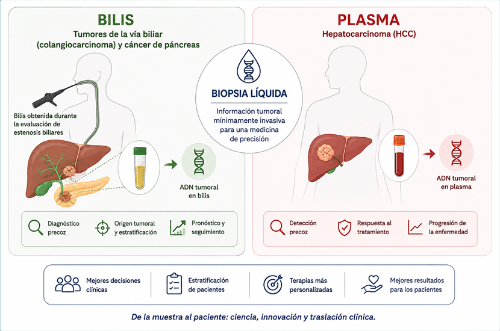
We are working on new liquid biopsy strategies based on the genetic and epigenetic analysis of circulating DNA in plasma and bile to improve the diagnosis and stratification of patients with hepatocellular carcinoma and biliary tract tumours. In parallel, we investigate the molecular mechanisms associated with response to and resistance against treatment, particularly immunotherapy, and use patient-derived organoids to replicate the disease in the laboratory and explore new therapeutic strategies.
Our ultimate aim is to translate this knowledge into precision medicine tools that enable earlier diagnosis and improved treatment for each patient.

Dra. Maria Arechederra
GROUP LEADER
| +34 948 194 700 | |
| macalderon@unav.es | |
| Research profile |
Oncology research integrated in the
Cancer Center Clinica Universidad de Navarra
Objectives of the Hepatology Research Group:
Diagnosis and Therapeutic Response
To move towards precision medicine in hepatobiliary cancer, integrating biomarkers, molecular knowledge and patient-derived models to improve diagnosis and treatment.

Diagnosis and stratification using liquid biopsy

Response to and resistance of treatment, and the development of new therapies.

Experimental models derived from patients.
10th European Club for Liver Cell Biology Meeting
Pamplona, Spain
22-24 September 2027
University of Navarra
 Lines of research of the Hepatology Research Group:
Diagnosis and Therapeutic Response
HepaMeth is a research programme focused on the development and application of epigenetic biomarkers in plasma to improve the management of patients with hepatocellular carcinoma. The project combines a translational component, aimed at developing liquid biopsy tools, with a mechanistic component to understand the biological significance of methylation patterns associated with different therapeutic responses.
Objectives:
- To develop and validate a liquid biopsy panel for early diagnosis and the prediction of treatment response.
- To investigate whether methylation patterns (epihaplotypes) associated with HepaMeth improve the overall performance of the panel and to identify profiles associated with response to or resistance to immunotherapy.
- To identify and validate mechanisms of resistance and new therapeutic vulnerabilities associated with these molecular profiles.
This line of research explores the potential of bile as a source of molecular information and as a biological material for generating patient-derived experimental models. It incorporates liquid biopsy strategies to improve the clinical management of patients with biliary strictures and at-risk populations, alongside the development of organoids to study the biology of the disease and identify new therapeutic options.
Objectives:
- To develop and validate bile-based liquid biopsy strategies to improve the diagnosis, stratification and prognosis of patients with biliary and pancreatic tumours.
- To investigate the utility of bile in patients with chronic biliary tract diseases and an increased risk of developing cholangiocarcinoma.
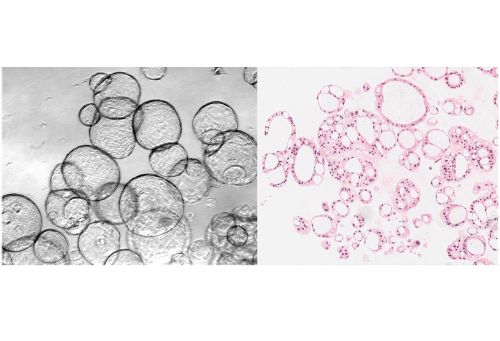
- Generate and characterise organoids derived from bile and patient tissue as experimental disease models.
- Use these models to study molecular mechanisms, validate biomarkers and identify new therapeutic strategies.
What’s more...
Liquid biopsy strategies in hepatobiliary cancer
We develop plasma- and bile-based tools to improve the diagnosis, stratification and clinical management of patients with hepatocellular carcinoma and biliary tract tumours.
We develop patient-derived organoids
We generate cellular models from bile and tumour tissue to study the disease, validate biomarkers and explore new therapeutic strategies.
Meet the research team


We would also like to highlight...
Relevant competitive grants
- Ramón y Cajal Grant RYC2024-048676-I. Principal investigator: María Arechederra. 2026–2031.
- AECC Research Grant 2022 (INVES223049AREC). Principal investigator: María Arechederra. Spanish Association Against Cancer. 2022–2026.
Patents
EP24382072.7 / PCT/EP2025/05173.
- In vitro method for the diagnosis and/or prognosis of liver cancer and/or for predicting patient response.
- Inventors: María Arechederra, Carmen Berasain, Idoia Bilbao, Manuel F. Landecho, Matías A. Ávila and Bruno Sangro
- Assignee: Cima, University of Navarra

Dr María Arechederra is a co-founder of the BileBank project, an international initiative with partners in Spain, France, Germany, Poland, Italy and the United Kingdom, which promotes the collection and study of bile as a source of biomarkers with potential diagnostic and therapeutic utility in hepatobiliopancreatic diseases.

Dr María Arechederra is a ‘Volunteer for Science’ with the Spanish Association Against Cancer (AECC) in Navarre and Álava. Through talks, hands-on workshops and other activities in schools, community centres and scientific events, she helps to bring cancer research closer to the public and to foster an interest in science and the importance of biomedical research.

Dr María Arechederra is the founder and editor of Dciencia, a non-profit science communication project in Spanish that encourages researchers themselves to explain their work in their own words, using language that is accessible to the general public.
In 2025, Dciencia exceeded 1.1 million visits. In 2024, it received the Award for Best Science Communication at the second edition of the Science in Spanish Awards, presented by the madri+d Foundation for Knowledge.
Scientific activity of the Hepatology Research Group:
Diagnosis and Therapeutic Response
Latest scientific publications
- Ultra-low-pass whole-genome sequencing of bile cfDNA in patients with biliary strictures Jul 31, 2026 | Magazine: eGastroenterology
- A guide for establishing patient-derived organoids from bile samples obtained during endoscopic procedures and performing gene expression knockdown May 29, 2026 | Magazine: Frontiers in Cell and Developmental Biology
- Histone methyl-transferase G9a inhibition boosts the efficacy of immune checkpoint inhibitors in experimental hepatocellular carcinoma [SP] Apr 21, 2026 | Magazine: Cell Reports Medicine
- Demonstration of SLU7 as a new cancer target Dec 18, 2025 | Magazine: Biomedicine & Pharmacotherapy